

A dishwasher can fail in several ways, but the symptoms homeowners report are not always evenly distributed across brands.
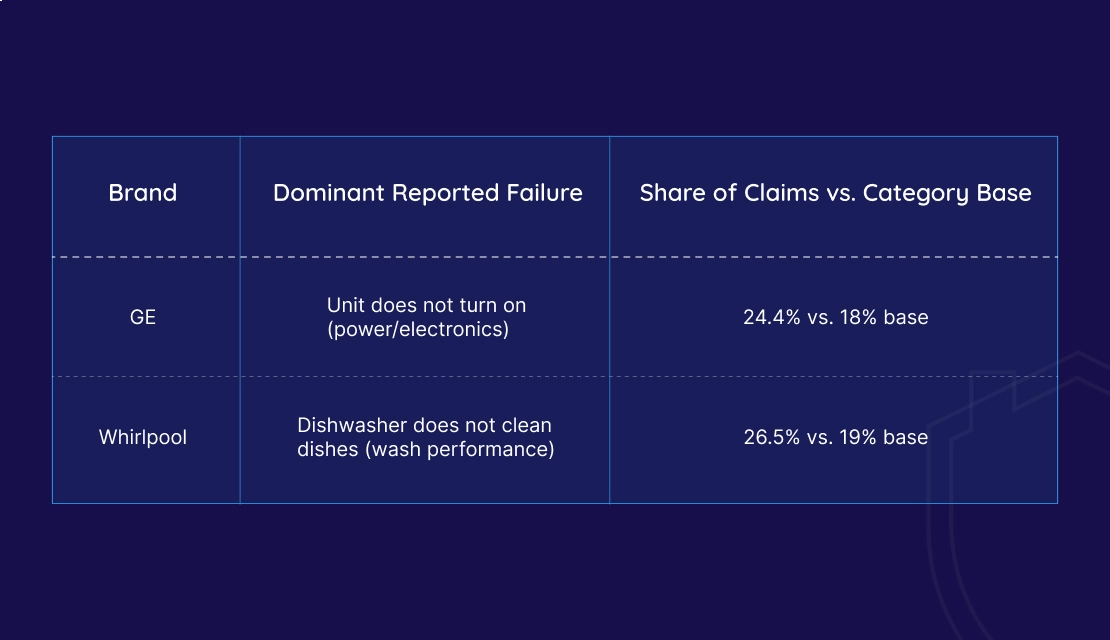
Home warranty claims data shows a clear difference in the dominant failure signatures reported for GE and Whirlpool dishwashers. For GE claim calls, 24.4% involve a unit that will not turn on, compared with an 18% category base. Whirlpool calls show a different pattern. 26.5% involve dishes not getting cleaned properly, compared with a 19% category base.
These figures do not measure defect rates or prove that either brand is less reliable overall. They represent the mix of claims within each brand and the types of problems homeowners most often report.
That distinction can still be useful. A dishwasher that will not power on follows a different diagnostic path than one completing cycles poorly. The technician may inspect different 24.4components, order different parts, and reach different conclusions.
The data shows that GE dishwasher problems are mostly about the unit not turning on at all. With Whirlpool, the bigger issue is often a machine that runs through the cycle but still leaves dishes dirty.
Both patterns sit well above the category-wide average for their respective complaint type. Neither number says one brand breaks more often than the other. It only shows which failure type shows up most inside each brand’s own claims mix.
When the equipment refuses to start, the symptoms can look a little different from one case to another. The display might stay completely dark, the controls may not respond, or the cycle may simply refuse to begin after pressing Start.
A technician may check several possible causes, such as:
The symptom alone does not always tell you which part has failed. A dishwasher that appears completely dead could have a power supply problem. It could also have a control issue that prevents normal startup. That makes a proper diagnosis especially important before estimating repair costs or determining how a claim may be handled.
Your machine may turn on, fill with water, and finish the entire cycle, yet your dishes can still come out dirty. That creates a different kind of diagnostic challenge. The technician may need to check whether the problem involves poor water circulation, spray action, temperature, detergent use, or loading patterns.
They may also need to determine if the dishwasher is not draining or if another component is causing the issue.
Common areas that may need inspection include:
Poor cleaning results can also lead to more no-fault-found visits. Your equipment may appear to complete its cycle normally, so the technician needs to determine whether an actual mechanical failure exists. Blocked spray arms, incorrect loading, detergent problems, or missed maintenance can sometimes look like an appliance breakdown. Checking these possibilities can help separate a performance issue from a component failure.
For proper care and maintenance of your equipment. you can read our blog: Dishwasher Cleaning & Maintenance Tips
The reported symptom gives the technician a starting point for the service visit. A GE appliance that will not power on may call for electrical or electronic testing. A Whirlpool dishwasher with poor cleaning performance may need checks of water movement and wash components.
That difference can shape several parts of the repair experience:
File your claim right now, and we’ll assign a local, experienced technician who already knows which failure type to check first.
National repair-cost data, including Angi and Home Advisor, put standard repairs between $165 and $325, with average repairs around $225. The final bill is driven more by the specific part than the brand name.
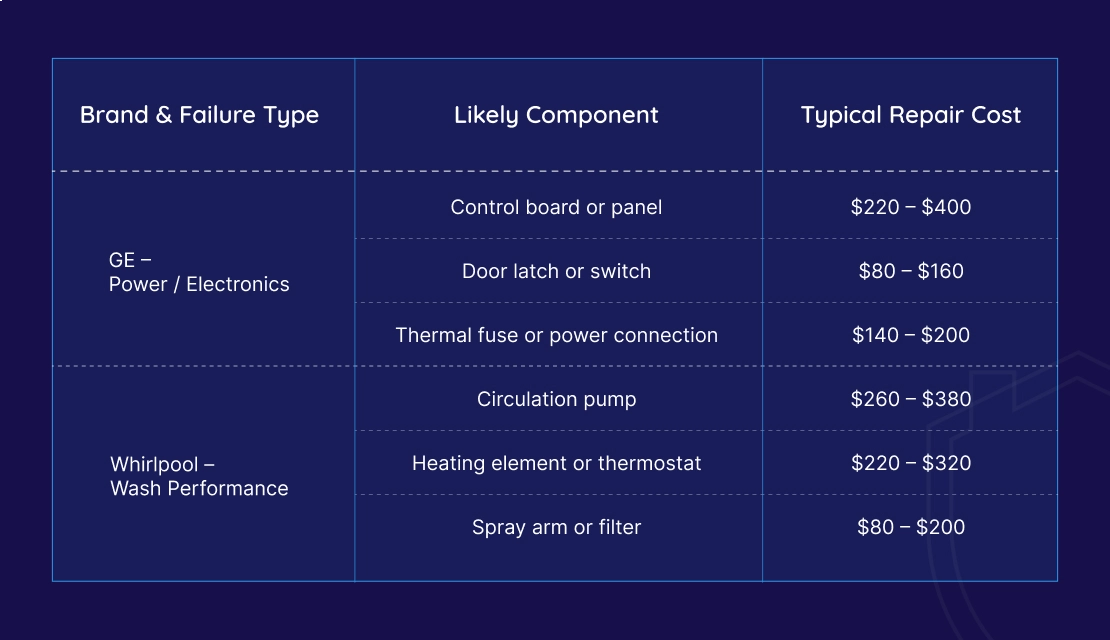
Cost ranges reflect current appliance repair-cost data reported by Angi, Home Advisor, and independent appliance-repair cost trackers.
Yes, most home warranty plans cover dishwasher repairs when a failure results from normal wear and tear. This can apply whether your machine will not turn on or simply is not cleaning dishes properly. Understanding how home warranties work can help you know what to expect before an appliance stops working.
Filing a home warranty claim generally follows similar steps, regardless of the appliance involved. First, you report the problem, such as a dishwasher that will not start. The provider then schedules a technician to inspect the issue. The technician diagnoses the problem and submits their findings for review. From there, the claim is handled according to your plan’s terms and coverage.
Because different symptoms can point to different diagnostic paths, describing the problem clearly can help start the right service process. A specific description gives the provider and technician more useful information than simply saying, “The dishwasher is broken.” For example, “The dishwasher runs but leaves dishes dirty” provides a clearer starting point for the home warranty claim process.
Knowing your appliance’s likely cause of failure before you call for service helps you describe the problem accurately. It also sets realistic expectations for which parts the technician may need to order. That kind of clarity shortens the distance between a reported symptom and a resolved claim, no matter which brand sits in your kitchen.

An appliance breakdown does not always have an obvious cause. The reported symptoms can vary, while a proper diagnosis helps identify what actually needs attention. Knowing what your appliance protection plan covers can help you understand your options if an appliance needs repair.
If you are comparing warranty providers, Select Home Warranty is one option worth considering. NerdWallet, Consumers Advocate, and U.S. News & World Report have included us among the top home warranty companies. Further, we were also recognized as a company that is “Best for Affordability” in September 2026 by CNBC Select. For coverage questions or a personalized quote, call +1 (855) 267-3532.
Review and compare our appliance protection options to get home warranty dishwasher coverage before the next unexpected breakdown creates an out-of-pocket repair decision.
A dishwasher may have power but fail to start because of a faulty door latch, control panel, timer, or electronic control component.
If cleaning filters, clearing spray arms, and checking the detergent does not solve the issue, the appliance may need professional diagnosis.
Yes. Loose connections, electronic controls, sensors, and other components can cause problems that appear and disappear during different cycles.
Repairing an older dishwashing appliance can make sense when the repair is minor. Replacement may be more practical when several major components are failing.
Most of the repairs take one to three hours once the technician has the required parts. Complex failures or unavailable parts can extend the timeline.
It is safer to stop using the appliance if you hear grinding, burning, or severe mechanical noises. Continued operation could worsen an underlying component problem.

Don’t wait until it’s too late! Check out our current plans and get your free quote.

Home Warranty
Owning a mobile home feels like an adventure, doesn’t it? It is a perfect blend of affordability, portability, and a cozy space to call your own - wherever you go...

Household Tips
You can plan for your mortgage. You can plan for your utilities. But what if your water heater gives out or your roof starts dripping during a rainstorm? That’s when..

Household Tips
When it comes to enjoying summer, there’s nothing quite like relaxing beside your own pool. That’s why on these bright and sunny days, sitting by a murky pool can be..